
The Heart of American Performance: Buell 1190cc V-twin Engine (Ep. 2)
Episode 2: New vs. Proven and the Anatomy of Performance
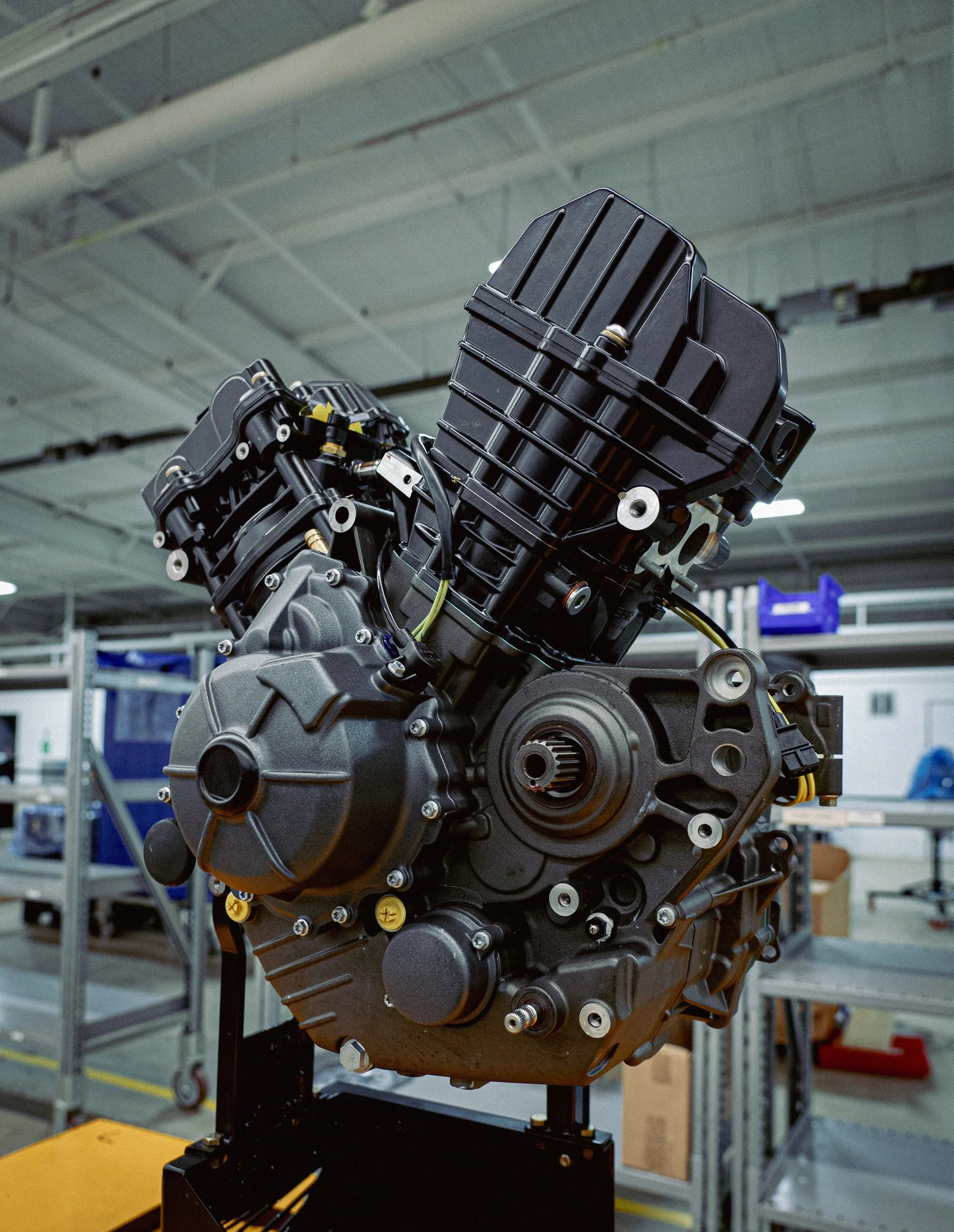
Buell 1190cc V-Twin Engine
To understand where Buell Motorcycle Co. is going, we must first understand the technical DNA of where we’ve been. Welcome back to “Engine Talks,” a series that dives into the heart of Buell’s flagship powertrain in pursuit of transparency and the understanding of raw power.
Today, we highlight our 1190cc V2 V-Twin engine platform to compare the perks and personalities carried over into three distinct milestones within Buell’s platform history:
The race-bred, track-only 1190RR
The industrialized 1190RX
The 1190cc platform that anchors today’s Hammerhead 1190/1190SX, SuperTouring, and the flagship Super Cruiser.
Leading this episode’s technical deep-dive is our very own long-time Buell veteran, Ed Laben. Laben has celebrated almost three decades with Buell, his tenure spanning every chapter of Buell’s engine history from the late 90’s to date, and his experience has continued to be a primary and thoroughly vetted source of information for multiple iterations of the 1190cc engine platform, including the V2 that we use today.
TECHNICAL NOTE: Unless specifically noted, all power specs for street-legal motorcycles in this series are rated in BHP. Track-restricted machines will remain in RWHP, the chosen method of measuring output on the grid.
Engine Maturity in the Powersports Industry
Motorcycle marketing thrives on the allure of the “all-new,” yet this movement rarely accounts for the realities of engine development. Scrapping a platform with evolution potential to create something entirely new from scratch can often introduce additional complexity, cost, and early-generation reliability challenges.
Because of this, many OEMs prioritize powertrain evolution over constant creation. Here are a few examples of manufacturers in the Powersports industry that have successfully prioritized long-term engine evolution:
| Manufacturer | Platform | Active Evolution Timeline | Impact |
|---|---|---|---|
| Harley-Davidson | Evolution (Sportster) | 36+ Years (1986–2022) |
Decades of refinement created one of the most widely refined engines in American history. |
| Ducati | Desmodue (2-Valve) | 40+ Years (1979–2020s) |
Core architecture was perfected across generations. |
| Suzuki | Hayabusa (GSX-R1300) | 25+ Years (1999–Present) |
A global benchmark for durability through constant engineering iteration. |
| Buell | 1190 V2 | 15 Years (2011–Present) |
A powertrain matured and supported with over a decade of R&D. |
For an OEM, the initial lifespan of an engine begins with a “Version 1.0” prototype, serving as a proof-of-concept for initial validation. Years of labor and hundreds of rigorous R&D tests allow fine-tuning for thermal management, durability, and reliability. Once this testing phase secures a stable foundation, the engine finally makes its official debut - a milestone that celebrates success within a massive chronological timeline.
Even as the production model manifests into a successful release, the cycle continues. Behind the scenes, the next chapter is already being written as teams identify, scope, and fund the platform’s next stage of evolution.
For over a century, this consistent strategy has ensured that a new engine can mature from a fresh release into a vetted, permanent staple and a proven legacy within a manufacturer’s family.
The 1190RR: A Bespoke Masterpiece (2010–2011)
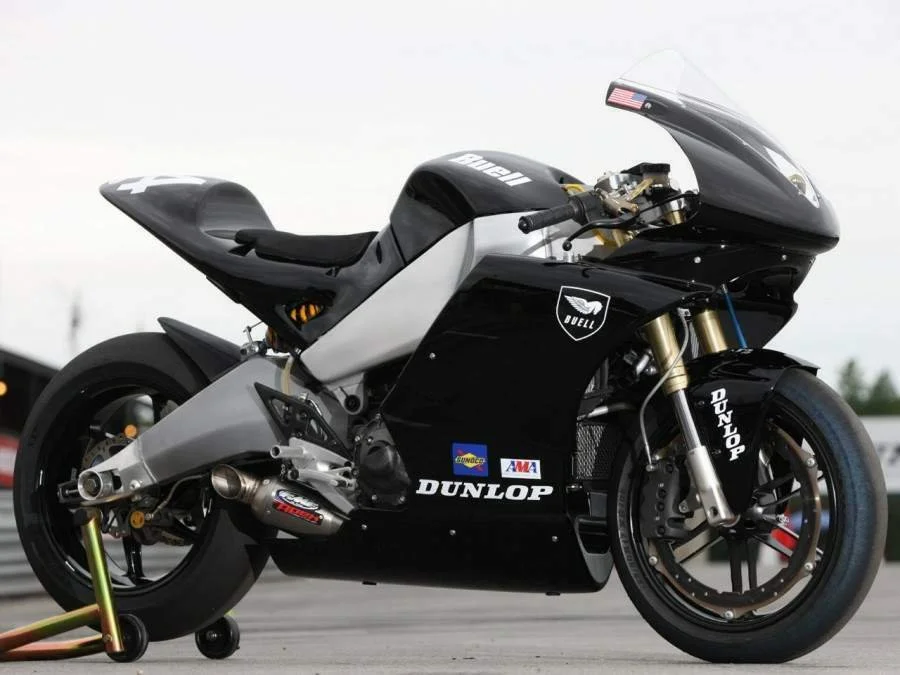
Buell 1190RR (via motorcyclespecs.co.za)
| Feature | Specification / Detail | Era Benefit |
|---|---|---|
| Power | 185 RWHP @ 11,500 RPM | Delivered a then-unrivaled power-to-weight ratio. |
| Torque | 93.0 lb-ft @ 9,500 RPM | Aggressive, “cammy,” unfiltered feedback for professional racing. |
| Purpose | Built for immediate track entry during EBR’s founding. | The first machine released by EBR; also the first machine to debut with the powerful 1190cc V-Twin platform. |
| Characteristics | Bespoke / Hand-Built “Upcycling” from modified 1125 inventory. | Established Buell's status as a global competitor while making use of East Troy’s leftover stock engines. |
The 1190RR was a handcrafted vehicle, created by Erik and his team for a shift to raw competitive track dominance for the AMA Superbike grid. In this era, the old 1125’s upcycling phase from 1125cc to 1190cc required a significant exercise in design and engineering capabilities. The final product upped the ante in every way possible.
“The RS and RR were very much like modified race engines,” says Ed. “The cylinder heads were seriously modified with big chunks hacked out of them and new CNC pieces welded in. We were essentially hand-hogging parts to see what we could develop out of them.”
Platform Characteristics & Field Comparison
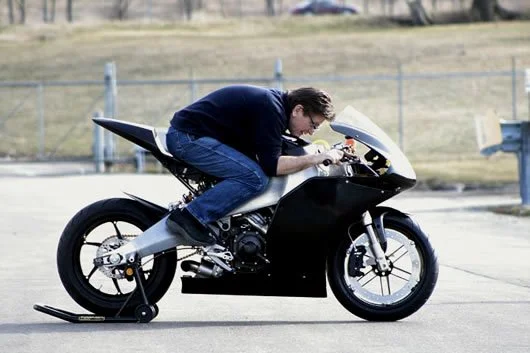
Erik Buell on the Buell 1190RR (via thekneeslider.com)
Characteristics of the track-only 1190RR were defined by a high-strung and "cammy" performance profile, delivering 185 horsepower to the rear wheel near the very top of the rev range. As output established a world-class benchmark of 2.55 hp per cubic inch, this was a setup that required a skilled racer to maintain the engine within its power band.
At this time, the 1190 platform’s internal componentry featured titanium intake valves and race-spec connecting rods equipped with specific racing-grade rod bolts, allowing the engine to withstand sustained operation at the redline. The 1190RR also utilized hand-modified 1125 cases, which were simpler due to the lack of a required track-side vehicle speed sensor.
It is worth noting at this time that the above manual tolerances necessitated frequent tear-downs to maintain peak integrity.
TECHNICAL SPECS: 1190RR / 1190RS
Type: 72° V-Twin, 4-Stroke, 4-valve DOHC
Displacement: 1190cc
Compression Ratio: 14.25:1 (1190RR) / 13.6:1 (1190RS)
Peak Power: 185 RWHP @ 11,500 RPM (1190RR) / 175 BHP @ 9,750 RPM (1190RS)
Peak Torque: 93.0 lb-ft @ 9,500 RPM (1190RR) / 97 lb-ft @ 9,400 RPM (1190RS)
The 1190RX: Industrialized Opulence (2012–2014)
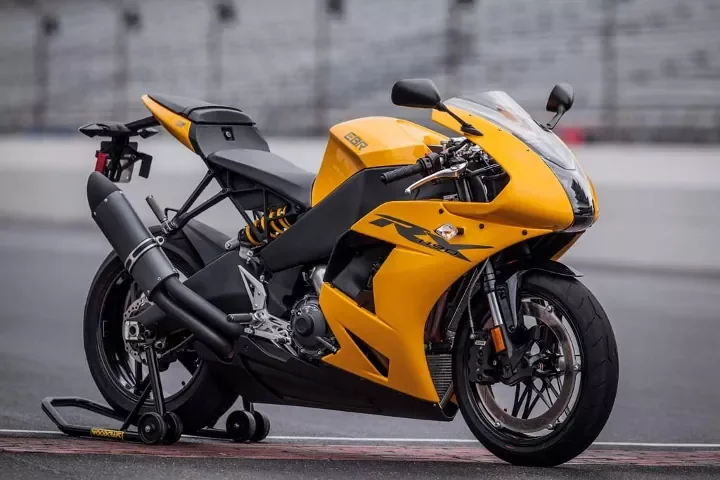
2014 Buell 1190RX (via motorcycle.com)
| Feature | Specification / Detail | Era Benefit |
|---|---|---|
| Power | 185 BHP @ 10,600 RPM | Established world-class superbike power for the production street market. |
| Torque | 101.6 lb-ft @ 8,200 RPM |
Power band was shifted lower for massive, accessible street acceleration without compromising on the 185 horsepower peak figures. Resulted in predictable, robust power for consistent street safety. |
| Purpose | Industrialization & Scaling | To move the 1190 platform from a “hand-built” racing experiment to a repeatable, scalable, and reliable production standard. |
| Characteristics |
|
|
Within the 2012-2014 year range, the 1190cc platform moved from an experiment to an industrialized standard. This era saw a clear transition from a hand-modified race engine to a fully industrialized, world-class powertrain known internally as the RX11, debuting shortly thereafter as the 1190RX.
At this point in the platform’s evolution, Computational Fluid Dynamics (CFD) was utilized to simulate the engine’s entire life with a cutting-edge precision uncommon for its time. While there were benefits to the hand-ported race heads of the 1190RR/RS, CFD allowed Buell to design a shape so ideal that it could be cast in a permanent mold, allowing air to flow more efficiently and at a better cost to the manufacturer.
Because of this evolution milestone, the 1190RX made superbike power even more accessible to the average street rider throughout the bike’s rev range, outperforming its predecessor.
“The RX engine has different performance characteristics than the RR because the RR was basically a race engine; the RX isn't that way, as it pulls much more from lower down,” supplies Ed. “As part of that industrialization and working with the supply base, we took those performance shapes and made them conform to manufacturing processes that were affordable and repeatable. We were able to come up with shapes and materials for the production parts that could be cast with cores in a permanent mold, actually providing the same or better flow than the race versions.
Ultimately, we developed a better-mannered powertrain that still made 185 horsepower.”
Platform Characteristics & Field Comparison
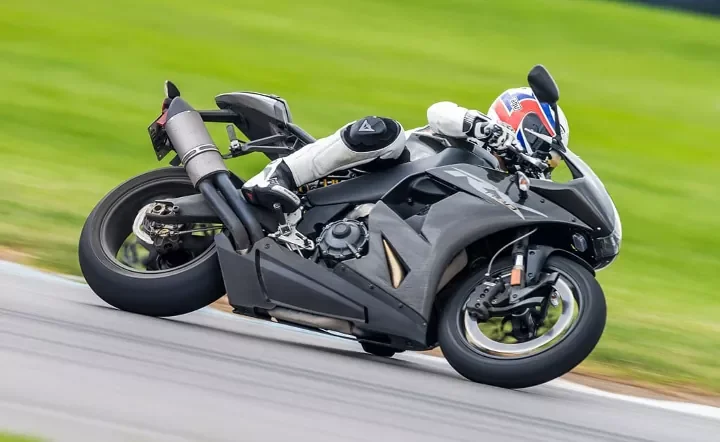
2014 Buell 1190RX (via motorcycle.com)
The 1190RX was engineered to deliver more accessible power, departing from the 1190RR’s aggressive profile by utilizing a smooth, massive torque curve of 101.6 lb-ft while maintaining 185 hp (BHP) of peak power at the crankshaft. This shift allowed the engine to pull much more effectively from lower in the RPM range.
Componentry transitioned to specialized production parts, featuring a completely redesigned crankshaft, rods, and pistons. Connecting rods were optimized for production volume and fitted with standard-grade bolts.
Architecturally, this era also introduced the first dedicated 1190cc engine platform casting, which included integrated speed sensor mounts to support street electronics. Porting was redesigned to be larger and more direct, significantly improving both emissions and tractability. A Helmholtz resonator system was also adopted for broader torque.
TECHNICAL SPECS: 1190RX (Legacy)
Type: 72° V-Twin, 4-Stroke, 4-valve DOHC, Liquid-Cooled
Displacement: 1190cc
Compression Ratio: 13.4:1
Peak Power: 185 BHP @ 10,600 RPM
Peak Torque: 101.6 lb-ft @ 8,200 RPM
The 1190cc V2 V-Twin: Precision Execution (2021–Present)
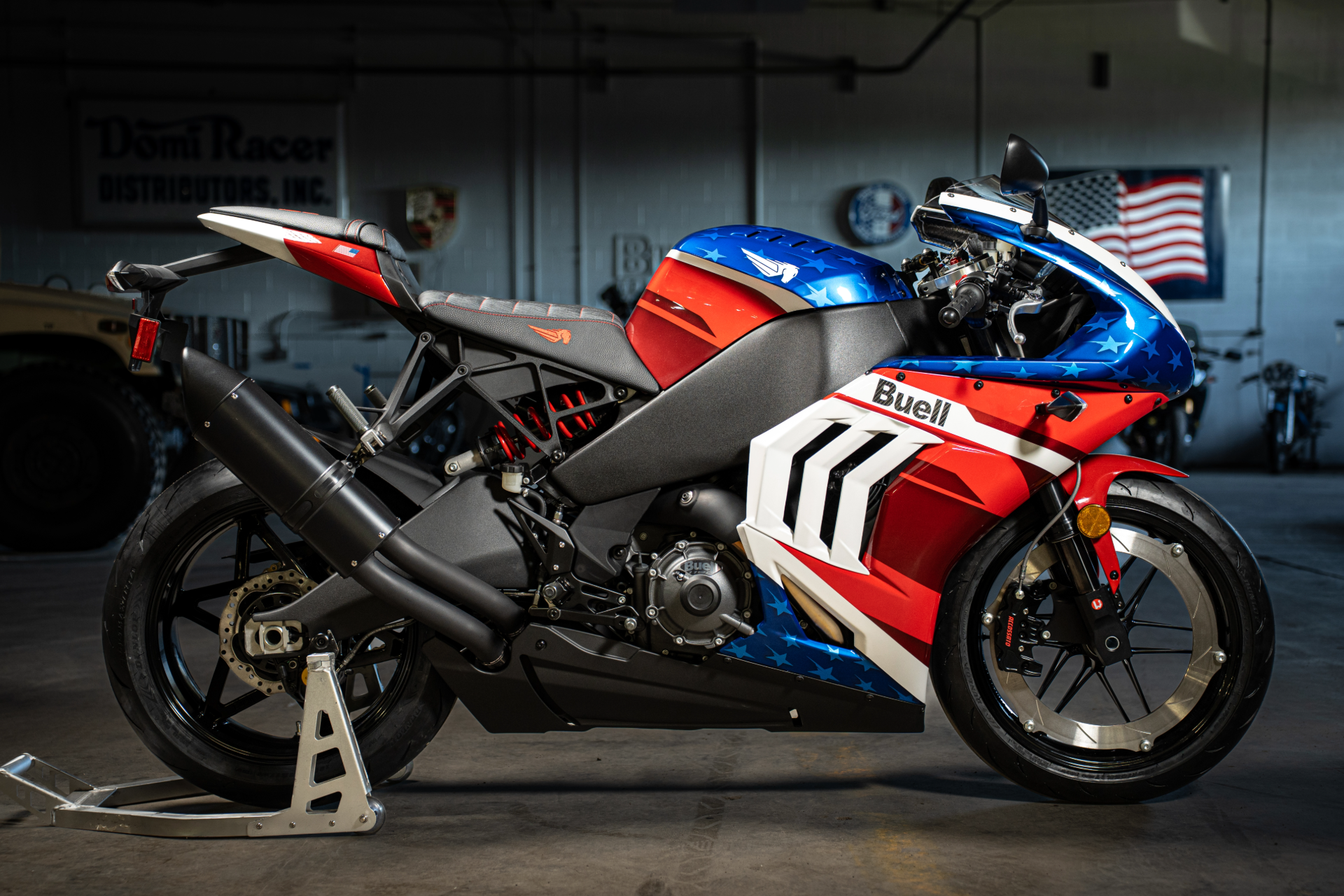
2026 Freedom Edition Buell Hammerhead 1190
| Feature | Specification / Detail | Benefit to the Era |
|---|---|---|
| Power | 185 BHP (Hammerhead/SX) / 175 BHP (Super Cruiser) | Refined, top-end power delivery across a diverse range of bike categories. |
| Torque | 101.6 lb-ft @ 8,200 RPM | The most linear and refined torque curve in the platform's history for "Full Feel" control. |
| Characteristics | Further Refinement & Reshoring Efficiency | Optimized supply chain with tighter tolerances and faster response to legacy mechanical challenges. Onshored critical machining (Minnesota/Michigan) and moved to back-purge-welded, cast-flange headers. |
Today’s engine represents the next evolution chapter of the 1190cc V-Twin platform. In this era, the company prioritizes an open focus, adapting a proven superbike engine architecture for a first-of-its-kind cruiser package with improved mechanical quality.
Supply chain efficiency remains a big company focus, with updating connections wherever possible:
“The supply base went through a transition where we had to react. For instance, the 1190’s raw castings are now machined in Minnesota instead of purchasing them outright,” explains Ed. “We are bringing that work here because our country has established industrial expertise in gear making, steel, heat treating, and aluminum machining, and we are taking as much advantage of that as we can.”
“We’re moving the gearbox and all the geared stuff to the U.S. to work with a new supply chain and to improve gear noise, which remains a big focus,” continues Ed. “We are also [phasing out of] the adjustable cam gear.”
Under Buell Motorcycle Co., today’s 1190cc engine platform delivers a refined and linear performance profile, specifically tuned for even smoother torque delivery. The clutch engagement has been massaged to ensure low-end accessibility without sacrificing the 185 horsepower at the top end for the Hammerhead 1190, 1190SX, SuperTouring, and 175 horsepower for the Super Cruiser.
While the 1190RX and the 1190cc V2 V-Twin in the Hammerhead 1190/1190SX share the same compression ratio (13.4:1), the jump to further refinements and tighter tolerances has been possible through the move to domestic machining in Minnesota and Michigan.
All of the above contribute to Buell’s most robust 1190cc engine platform version to date.
TECHNICAL SPECS: MODERN 1190cc V2 V-Twin
Type: 72° V-Twin, 4-Stroke, 4-valve DOHC, Liquid Cooled
Displacement: 1190cc
Compression Ratio: 13.4:1
Peak Power: 185 BHP @ 10,600 RPM (Hammerhead 1190/1190SX) / 175 BHP @ 9,750 RPM (Super Cruiser)
Peak Torque: 101.6 lb-ft @ 8,200 RPM (Hammerhead 1190/1190SX) / 94 lb-ft (Super Cruiser)
The Super Cruiser: A Specialized Application of the V2 V-Twin
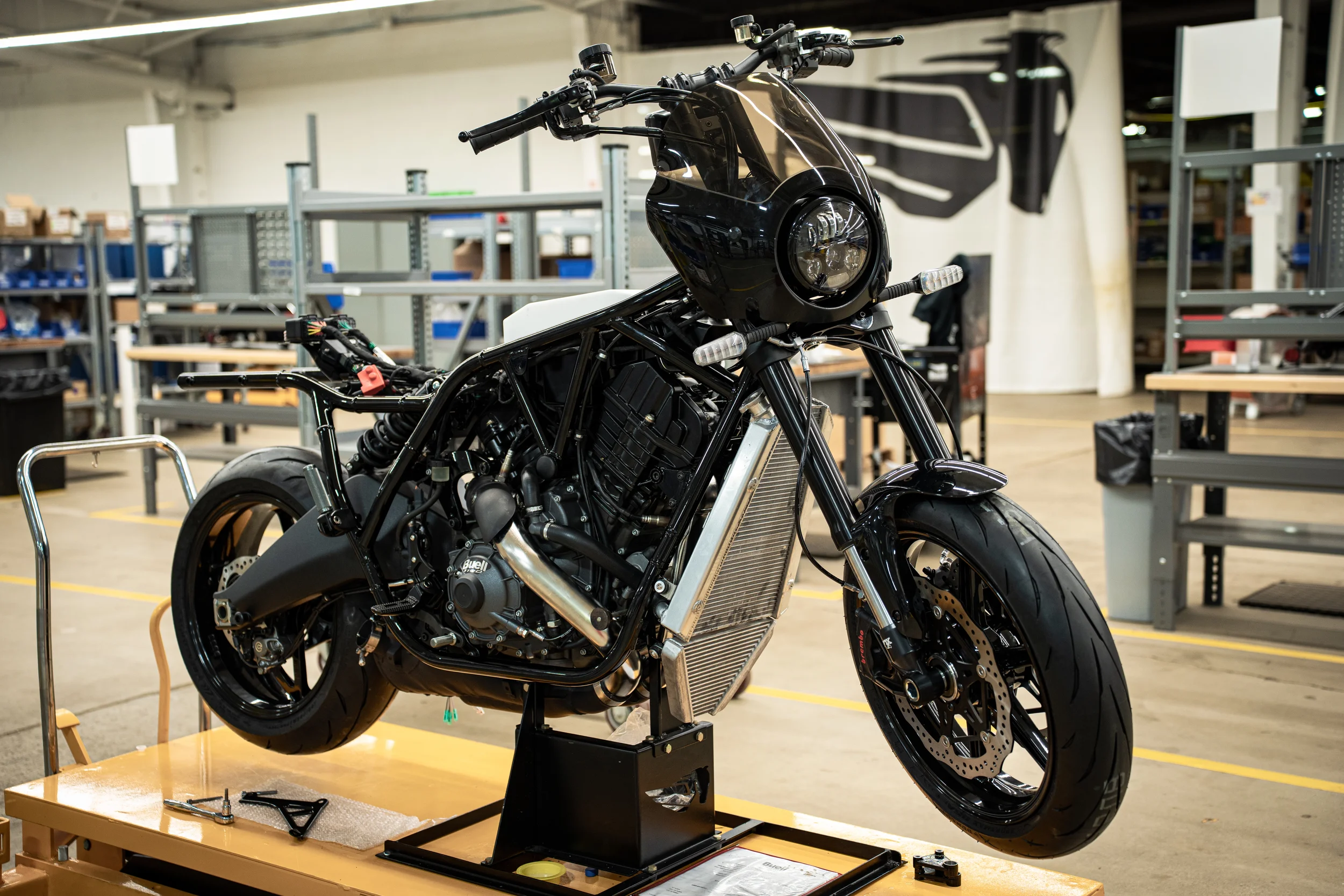
2026 Buell Super Crusier
While the 1190cc V2 V-Twin anchors Buell’s high-performance sportbikes, the Super Cruiser utilizes the same architecture, albeit with a powertrain recalibrated to prioritize a "Full Feel" experience, aligning the engine’s behavior with cruiser-style riding and ergonomics.
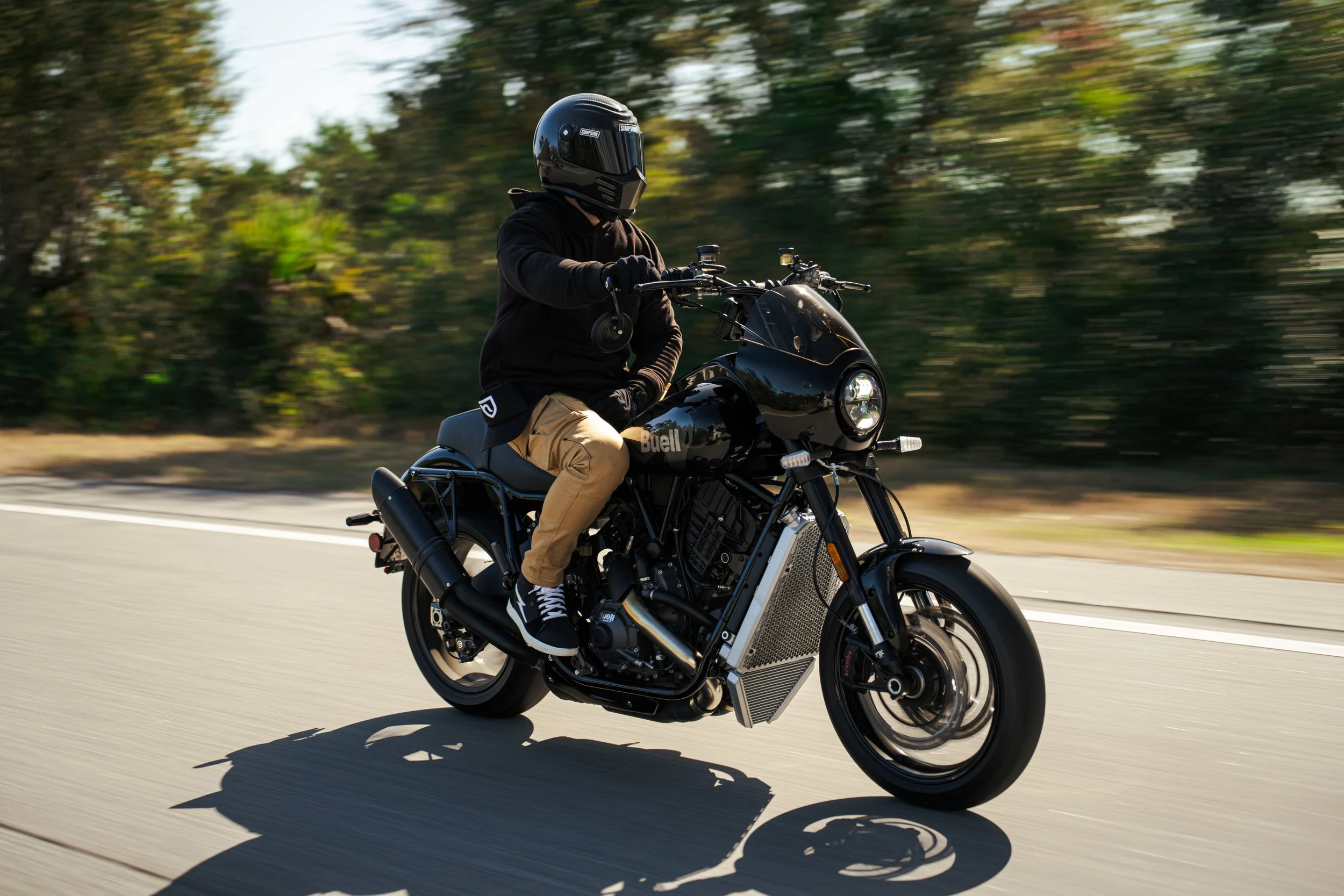
2026 Buell Super Cruiser
Linear Accessibility
The engine was remapped to deliver a more linear and predictable torque curve. By targeting 94 lb-ft at 8,500 RPM, engineers prioritized predictable power for low-speed urban manageability without sacrificing the 175 horsepower and trademark "Buell bite" at highway speeds.
Clutch Engagement & Refinement
The hydraulic slipper clutch was updated with optimized spring rates specifically for the Super Cruiser. This provided a lighter lever pull and smoother engagement while reducing hand fatigue - all critical for balancing superbike-level shifting precision to a chassis with more relaxed, cruiser ergonomics.
Thermal Management
To manage heat during long-distance hauls, back-purge welding technology has been utilized to further prevent internal oxidation. Thanks to this and modern domestic machining techniques, the Super Cruiser manages the thermal output of the 1190cc V2 V-Twin platform even more efficiently than its predecessors, ensuring a bike that runs cooler and with more comfort during sustained hauls.
14 years of 1190cc V-Twin engine development to the cruiser category brings a unique level of mechanical maturity previously unavailable in the American cruiser market.
American Alliances: Domestic Support & Partnerships
Components continue to be sourced domestically wherever possible. On the Super Cruiser specifically, componentry benefiting from that country-wide support includes:
Memphis Shades front fairing (Tennessee, USA)
Saddlemen Seat (California, USA)
Dunlop Tires (New York, USA)
Fox Factory suspension package (California, USA)
Frame sourced from Pennsylvania, USA
Tanks sourced from Michigan, USA
Buell Motorcycle Co. is proud to partner with these organizations to contribute to the future of the enduring legacy of American manufacturing.
Stay tuned for Episode Three of this series, where we dive into Buell’s racing heritage and how Erik’s passion for performance made world-class grid power for every rider.
For all the latest news, updates, and exciting developments happening here at Buell, be sure to visit our growing content archives at www.buellmotorcycle.com.